Key Takeaways
- CDC milestones are based on what 75% of children can do by a specific age — not the earliest possible
- Development happens across 4 domains: social/emotional, language, cognitive, and motor
- Missing one milestone isn't cause for alarm — a pattern of delays across domains is
- Early intervention (before age 5) is significantly more effective than waiting
- Every child develops at their own pace — milestones are guideposts, not deadlines
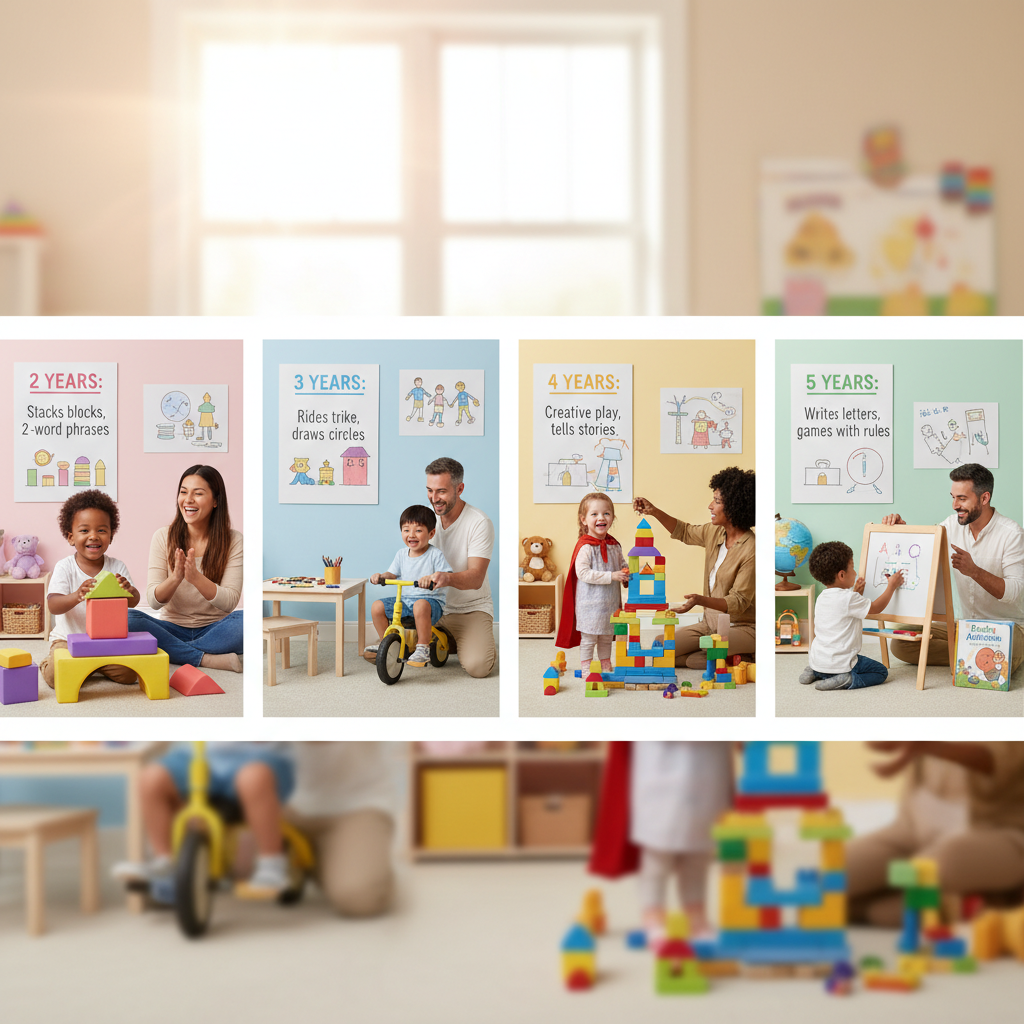
Between ages 2 and 5, your child transforms from a toddler who speaks in two-word phrases to a child who tells stories, makes friends, and gets ready for school. The developmental leaps are enormous — and sometimes hard to track.
This guide covers the CDC developmental milestones for ages 2-5, organized by age and domain. Use it as a reference, not a checklist to stress over. Every child develops at their own pace.
For baby milestones (0-12 months), see Baby Milestones Month by Month. For activities that support development, see Best Activities for Toddler Development.
Milestones at 2 Years (24 months)
Social/Emotional
- Notices when others are hurt or upset (may pause or look sad)
- Looks at your face to see how to react in new situations
- Plays alongside other children (parallel play)
Language/Communication
- Uses at least 50 words
- Puts two words together ("more milk," "daddy go")
- Points to things in a book when asked ("where's the dog?")
- Uses more gestures than just waving and pointing (blows kisses, nods yes)
Cognitive
- Holds something in one hand while using the other (holds cup, stirs with spoon)
- Tries to use switches, knobs, or buttons on toys
- Plays with more than one toy at the same time (puts toy food on toy plate)
Motor
- Kicks a ball
- Runs
- Walks up a few stairs with or without help
- Eats with a spoon
Milestones at 3 Years (36 months)
Social/Emotional
- Calms down within 10 minutes after you leave (at daycare, with grandparents)
- Notices other children and joins them to play
- Takes turns in games (with prompting)
Language/Communication
- Talks in sentences of 3+ words ("I want juice")
- Asks "who," "what," "where," or "why" questions
- Says first name when asked
- Talks well enough for most people to understand (most of the time)
Cognitive
- Draws a circle when you show them how
- Avoids touching hot objects after being warned
- Puts on some clothes by themselves (loose pants, jacket)
- Names a few colors
Motor
- Strings items together (large beads, pasta)
- Pedals a tricycle
- Catches a large ball most of the time
The 75% rule
CDC milestones represent what 75% of children can do by that age. If your child hasn't hit a milestone right at the target age, it doesn't automatically mean there's a problem. But if they're missing multiple milestones or falling further behind over time, that's worth discussing with your pediatrician.
Milestones at 4 Years (48 months)
Social/Emotional
- Pretends to be something else during play (teacher, superhero, dog)
- Asks to go play with other children (without being told to)
- Comforts others who are hurt or sad
- Avoids danger (doesn't jump from unsafe heights)
Language/Communication
- Says sentences with 4+ words
- Says some words from a song, story, or nursery rhyme
- Talks about at least one thing that happened during the day
- Answers simple questions ("what is a coat for?")
Cognitive
- Names a few numbers
- Uses words about time (yesterday, tomorrow, morning, night)
- Draws a person with 3+ body parts
- Can say some letters of the alphabet
Motor
- Catches a large ball most of the time
- Serves themselves food or pours water (with supervision)
- Unbuttons some buttons
- Holds crayon/pencil between fingers and thumb (not fist)
Milestones at 5 Years (60 months)
Social/Emotional
- Follows rules or takes turns when playing with other children
- Sings, dances, or acts for you
- Does simple chores (clears plate, puts away toys with reminding)
Language/Communication
- Tells a story they heard or made up (with at least 2 events)
- Answers simple questions about a book or story
- Keeps a conversation going (more than 3 back-and-forth exchanges)
- Uses or recognizes simple rhymes (bat-cat, ball-tall)
Cognitive
- Counts to 10
- Names some numbers between 1-5 when pointed to
- Uses words about time correctly (yesterday, tomorrow)
- Pays attention for 5-10 minutes during activities
- Writes some letters in their name
Motor
- Buttons some buttons
- Hops on one foot
- Eats with a fork and spoon without much spilling
When to Talk to Your Pediatrician
Talk to your doctor if your child:
- At 2 years: Doesn't use 2-word phrases, doesn't know what to do with common objects (brush, phone, spoon), doesn't copy actions or words, doesn't walk steadily
- At 3 years: Falls down a lot or has trouble with stairs, drools or has unclear speech, can't work simple toys, doesn't speak in sentences, doesn't understand simple instructions
- At 4 years: Can't retell a favorite story, doesn't follow 3-step commands, doesn't understand "same" and "different," doesn't use "me" and "you" correctly, has trouble scribbling
- At 5 years: Doesn't show a wide range of emotions, is extremely withdrawn, can't tell what's real vs make-believe, can't give first and last name, doesn't draw pictures
- At any age: Loses skills they once had, doesn't make eye contact, doesn't respond to their name, shows repetitive behaviors with no clear purpose
Early intervention works
Research consistently shows that early intervention (before age 5) is significantly more effective than waiting. If you have concerns, don't wait for the next well-child visit — call your pediatrician. Early evaluation doesn't mean something is wrong; it means you're being proactive.
How Tracking Milestones Helps
Tracking developmental milestones serves several purposes:
- Spot patterns early — a single missed milestone isn't concerning, but a pattern across domains (language + social + motor) warrants evaluation
- Prepare for well-child visits — "they can do X but not Y" is more useful than "I think they're fine"
- Celebrate progress — development feels slow day-to-day but looking back over months shows enormous growth
- Reduce anxiety — checking off milestones as they happen is more reassuring than worrying in the abstract
ParAI includes CDC developmental milestones for ages 0-5, letting you track which milestones your child has reached. The AI Milestone Analysis (Premium) compares your child's progress to CDC norms and highlights areas that may benefit from extra attention or activities.
Frequently Asked Questions
My child is ahead in some areas and behind in others. Is that normal?
Completely normal. Development is uneven — a child might be advanced in language but average in motor skills, or vice versa. Concern arises when a child is significantly behind in multiple domains simultaneously.
Should I compare my child to other children their age?
Milestones are useful guideposts, but comparing to specific peers is unhelpful. Children develop at different rates, and the normal range is wide. Compare your child to the milestone guidelines, not to the most advanced child at the playground.
My child was premature. Should I adjust for their corrected age?
Yes, for the first 2-3 years. If your child was born 2 months early, use their corrected age (actual age minus 2 months) when checking milestones. Most premature children catch up by age 2-3, but discuss with your pediatrician.
What's the difference between a delay and a disorder?
A delay means a child hasn't reached a milestone by the expected age but may catch up with time or support. A disorder (like autism or a language disorder) is a specific condition that affects development in characteristic ways. Only a professional evaluation can distinguish between the two.
How can I support my child's development at home?
The best things you can do: read together daily, talk to them constantly (narrate your day), provide unstructured play time, limit screens, ensure adequate sleep, offer social opportunities with peers, and respond to their interests. You don't need expensive programs — engaged, responsive parenting is the most powerful developmental tool.
Track Milestones & Get AI Developmental Insights
ParAI tracks CDC milestones and uses AI to spot patterns, suggest activities, and alert you if something needs attention. Personalized to your child's age.