Key Takeaways
- AAP recommends no screens under 18 months except video chat
- Ages 2–5: limit to 1 hour/day of high-quality content
- Background TV is more harmful than direct viewing
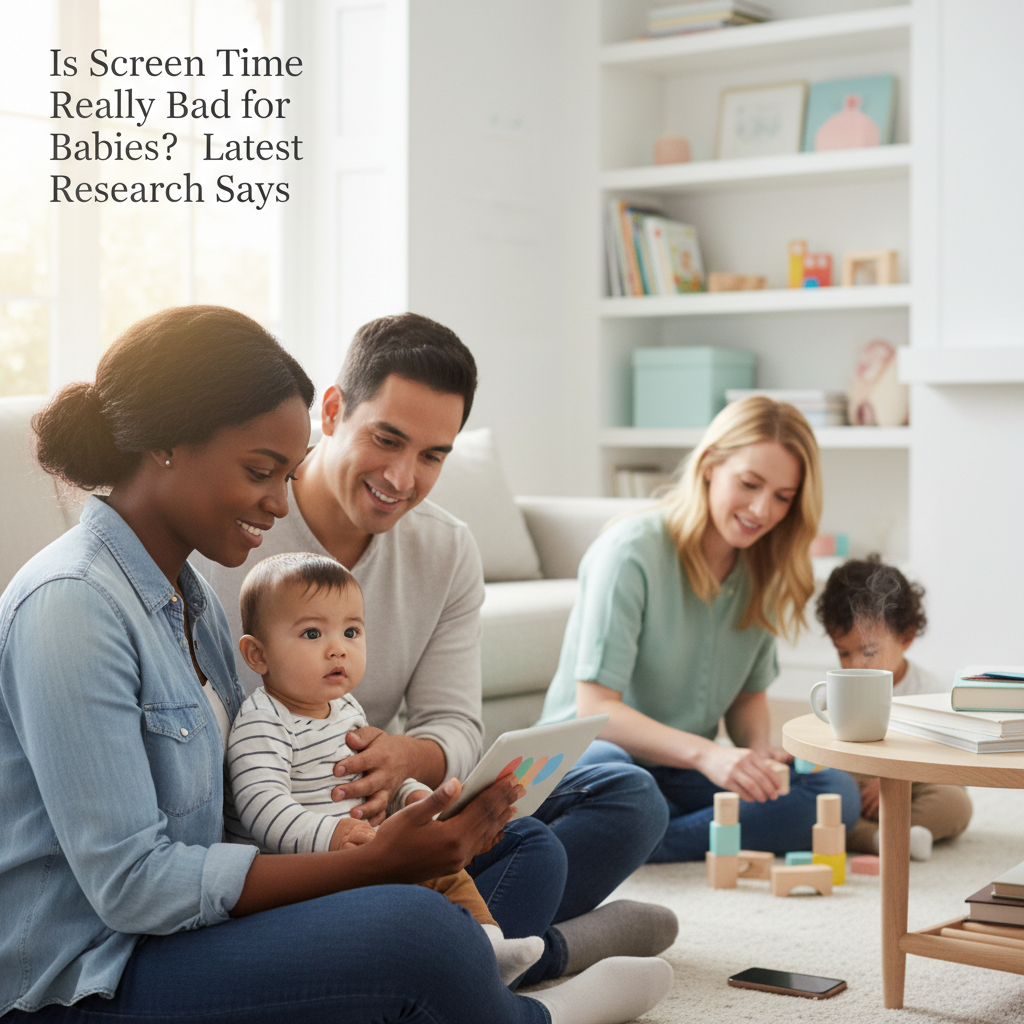
- Co-viewing with narration turns passive watching into active learning
- Quality matters more than quantity — not all screen time is equal
Every parent has heard it: "Screens are bad for babies." But is it really that simple? The reality is more nuanced than headlines suggest. Let's look at what the latest research actually says — no guilt trips, just evidence.
What AAP Actually Recommends
The American Academy of Pediatrics (AAP) provides clear, age-based guidelines that have been consistent since 2016:
See also: Best Toddler Tracking Apps: Meals, Behavior & Screen Time and Screen Time Limits by Age: AAP Guidelines for 2026.
- Under 18 months: Avoid all screen media except video chatting (e.g., FaceTime with grandparents)
- 18–24 months: If you choose to introduce media, select high-quality programming and watch it together with your child
- 2–5 years: Limit screen use to 1 hour per day of high-quality programs. Co-view when possible
These aren't arbitrary numbers. They're based on decades of developmental research showing how young brains learn best — through interactive, real-world experiences with caregivers.
Video chat is different
The AAP specifically exempts video calls because they involve real-time social interaction. A baby waving at grandma on FaceTime is engaging in genuine back-and-forth communication — fundamentally different from passively watching a screen.
What the Research Shows
Recent large-scale studies have given us a clearer picture of how early screen exposure affects development:
Language development: A 2023 JAMA Pediatrics study of over 7,000 children found that each additional hour of daily screen time at age 1 was associated with a 1.3-point reduction in communication scores at age 2. The effect was strongest for passive viewing without caregiver interaction.
Attention: Research from the National Institutes of Health (ABCD study) shows that children with more than 2 hours of daily screen time before age 3 scored lower on attention and executive function tests at age 5. However, the effect size was modest — equivalent to about 2–3 months of developmental difference.
Sleep disruption: A 2022 meta-analysis in Sleep Medicine Reviews found that screen use in the hour before bedtime reduced total sleep by 20–30 minutes per night in children under 3. Blue light suppresses melatonin, but the stimulating content is equally problematic.
Important context: Most studies show associations, not proven causation. Families with more screen time may differ in other ways (stress levels, available time for interaction) that also affect development.
How Screens Can Affect Development
The concern isn't that screens emit harmful rays — it's about what they replace and how young brains process them:
- Displacement effect: Every minute watching a screen is a minute not spent in face-to-face interaction, physical exploration, or creative play — all critical for brain development
- Transfer deficit: Children under 2 struggle to transfer what they see on a 2D screen to the 3D world. A toddler who can stack blocks on an app often can't do it with real blocks
- Reduced parent talk: Studies show parents speak 90% fewer words when a TV is on in the background. This "language gap" compounds over time
- Overstimulation: Fast-paced content (rapid scene changes every 2–3 seconds) can overwhelm developing attention systems, making slower real-world activities feel boring
Background TV is the hidden problem
Even when babies aren't watching, background television reduces the quality and quantity of parent-child interaction. A TV on in the background disrupts play patterns and decreases parental responsiveness. Turn it off when not actively watching.
When Screen Time Isn't Harmful
Research consistently shows that context matters enormously. Not all screen time carries the same risks:
- Video chat with family: Genuinely interactive and social. Babies as young as 6 months benefit from seeing and responding to familiar faces on screen
- Co-viewing with narration: When a parent watches alongside and narrates ("Look, the cat is jumping! Can you jump?"), children learn significantly more than watching alone
- Slow-paced, educational content: Programs like Sesame Street and Bluey are designed with child development principles. They pause for responses and model social skills
- Creative use: Older toddlers using drawing apps or making music are actively creating, not passively consuming
The key distinction is passive consumption vs. active engagement. A child scrolling through YouTube autoplay is in a fundamentally different cognitive state than one video-calling a grandparent or watching a show with a parent who asks questions.
Practical Guidelines by Age
| Age | Recommended Limit | What's OK | What to Avoid |
|---|---|---|---|
| 0–18 months | None (except video chat) | FaceTime with family, brief photo viewing together | Background TV, YouTube, baby apps |
| 18–24 months | Minimal, always co-viewed | Short educational videos watched together | Solo viewing, fast-paced content, ads |
| 2–3 years | Under 1 hour/day | Sesame Street, Bluey, Daniel Tiger with parent | YouTube autoplay, screens before bed |
| 3–5 years | 1 hour/day | Educational apps, creative tools, curated shows | Violent content, unboxing videos, unsupervised browsing |
The bedtime rule
Regardless of age, avoid all screens for at least 1 hour before bedtime. This single change improves sleep onset by an average of 20 minutes and increases total sleep duration. It's the highest-impact screen time rule you can implement.
Screen-Free Alternatives
The best way to reduce screen time isn't willpower — it's having better alternatives ready:
- Sensory play: Water play, playdough, sand, rice bins — deeply engaging for babies and toddlers
- Music and movement: Dancing, singing, simple instruments. Builds rhythm, coordination, and language
- Books: Even "reading" to a 6-month-old builds vocabulary. Board books they can chew on count
- Outdoor time: Nature is the ultimate sensory experience. A walk around the block offers more stimulation than any app
- Kitchen involvement: Toddlers love stirring, pouring, and tearing lettuce. Messy but developmental gold
- Independent play: A basket of safe objects (wooden spoons, containers, fabric scraps) can occupy a baby for 20+ minutes
The goal isn't zero screens — it's ensuring screens don't become the default activity. When you do use screens, make it intentional: choose the content, set a time limit, and when possible, watch together.
Experience AI-Powered Parenting with ParAI
SmartSpot predictions, natural language logging, AI Sleep Coach, and personalized insights — all in one app. See what AI can do for your family.


Disclaimer: This article is for informational purposes only and does not replace professional medical advice. Always consult your pediatrician for concerns about your baby's health or development.