Key Takeaways
- Most babies say their first real words between 10–14 months
- By age 2, most toddlers use 50–200 words and start combining two-word phrases
- Bilingualism does NOT cause speech delay — total vocabulary across languages is what counts
- Early intervention (before age 3) is the most effective time for speech therapy
From the first coo to full sentences, your baby's speech development is one of the most exciting milestones to witness. Every baby develops at their own pace, but understanding the general timeline helps you know what to expect — and when to seek help if needed.
Speech Development Timeline
| Age | Milestone | Vocabulary |
|---|---|---|
| 0–3 months | Cooing, vowel sounds (aah, ooh) | — |
| 4–6 months | Babbling, consonant sounds (ba, da, ma) | — |
| 7–9 months | Mama/dada without meaning, varied babbling | — |
| 10–12 months | First real words with meaning | 1–3 words |
| 12–18 months | Vocabulary explosion, pointing + words | 10–50 words |
| 18–24 months | Two-word phrases ("more milk," "daddy go") | 50–200 words |
| 2–3 years | Sentences, questions, storytelling | 200–1,000 words |
Receptive language comes first
Babies understand far more than they can say. By 12 months, most babies understand 50+ words even if they only say 1–3. Comprehension is just as important as production.
See also: Toddler Won't Listen? Positive Discipline Strategies by Age (1-5) and When to Start Sleep Training: Methods, Timing & What to Expect.
First Words: What to Expect
A baby's first words are usually simple, high-frequency words tied to their daily life. The most common first words include:
- Mama and dada — often the very first, because the sounds are easiest to produce
- Ball, dog, cat — objects they see and interact with daily
- More, no — functional words that get results
- Bye-bye — a social word reinforced by waving
Don't worry if your baby's first word is something unexpected. Some babies start with "uh-oh" or the family pet's name. What matters is that they're using sounds intentionally to communicate meaning.
How to Encourage Talking
- Narrate your day — describe what you're doing: "Now we're putting on your socks. These are blue socks!"
- Read daily — even 10 minutes of reading exposes babies to rich vocabulary and sentence patterns
- Respond to babbling — treat babbling like conversation. When they say "ba ba," respond: "Yes! Bottle! You want your bottle?"
- Don't correct — expand — if your child says "Dog!" respond with "Yes, big brown dog!" instead of "Say it properly"
- Sing songs — nursery rhymes build rhythm, repetition, and vocabulary
- Limit screen time — screens don't teach language the way human interaction does. Live conversation is irreplaceable
- Wait for a response — pause after asking a question. Give your baby time to process and attempt a reply
Quality over quantity
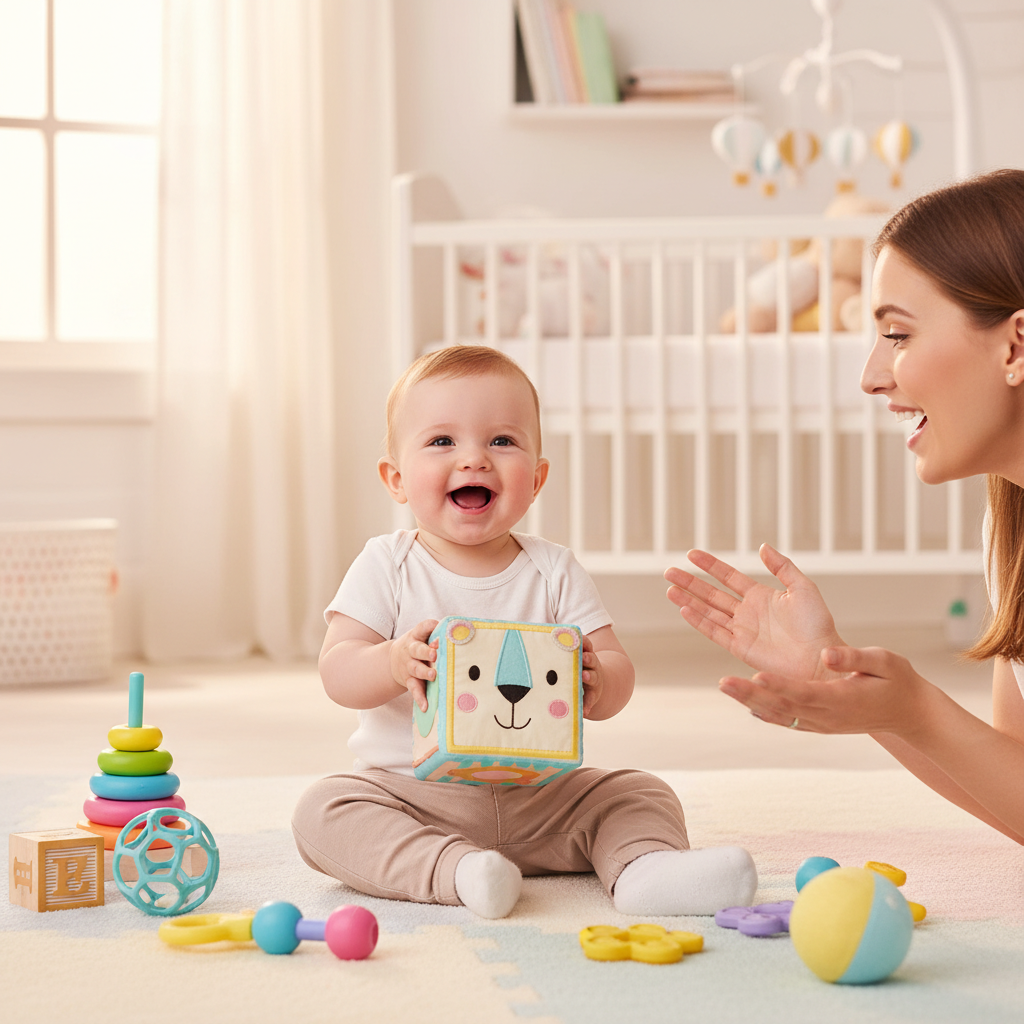
It's not about how many words you say to your baby — it's about back-and-forth interaction. Serve-and-return conversations (where you respond to your baby's sounds and gestures) are the single best predictor of language development.
Bilingual Babies
If your family speaks more than one language, you might worry that it will confuse your baby or delay their speech. Research consistently shows this is not the case:
- Bilingualism does NOT cause speech delay — bilingual children hit milestones on the same timeline as monolingual children
- Code-switching is normal — mixing languages in a single sentence is a sign of linguistic sophistication, not confusion
- Total vocabulary counts — a bilingual child may know 25 words in each language (50 total), which is equivalent to a monolingual child knowing 50 words
- Each language strengthens the other — bilingual children often develop stronger metalinguistic awareness
Speak to your baby in whichever language feels most natural to you. Consistency and richness of input matter more than which language you choose.
Signs of Speech Delay
While every child develops differently, certain red flags warrant attention:
- No babbling by 9 months — babies should be producing varied consonant-vowel combinations
- No words by 15 months — at least one meaningful word is expected by this age
- No two-word phrases by 24 months — combining words ("more juice," "mama up") should emerge by age 2
- Loss of previously acquired words — regression is always a reason to consult a professional
- Not responding to their name by 12 months — this may indicate hearing issues or other developmental concerns
Trust your instincts
You know your child best. If something feels off, don't let anyone dismiss your concerns with "they'll grow out of it." Early evaluation has no downside — if everything is fine, you get peace of mind. If there's a delay, you get a head start on support.
When to Seek Evaluation
If you notice any of the red flags above, don't adopt a "wait and see" approach. Here's why acting early matters:
- Early intervention is free — in the US, Early Intervention services (birth to age 3) are federally funded and available at no cost to families
- The brain is most plastic before age 3 — speech therapy is significantly more effective during this critical window
- Evaluation doesn't mean something is wrong — many children evaluated turn out to be within normal range. The evaluation itself is informative, not harmful
- Late talkers can catch up — but not always — some children are simply late bloomers, but without evaluation you can't distinguish a late bloomer from a child who needs support
Start by talking to your pediatrician, or contact your local Early Intervention program directly. You don't need a referral — parents can self-refer in most areas.
Track Milestones & Get AI Developmental Insights
ParAI tracks CDC milestones and uses AI to spot patterns, suggest activities, and alert you if something needs attention. Personalized to your child's age.


Disclaimer: This article is for informational purposes only and does not replace professional medical advice. Always consult your pediatrician for concerns about your baby's health or development.