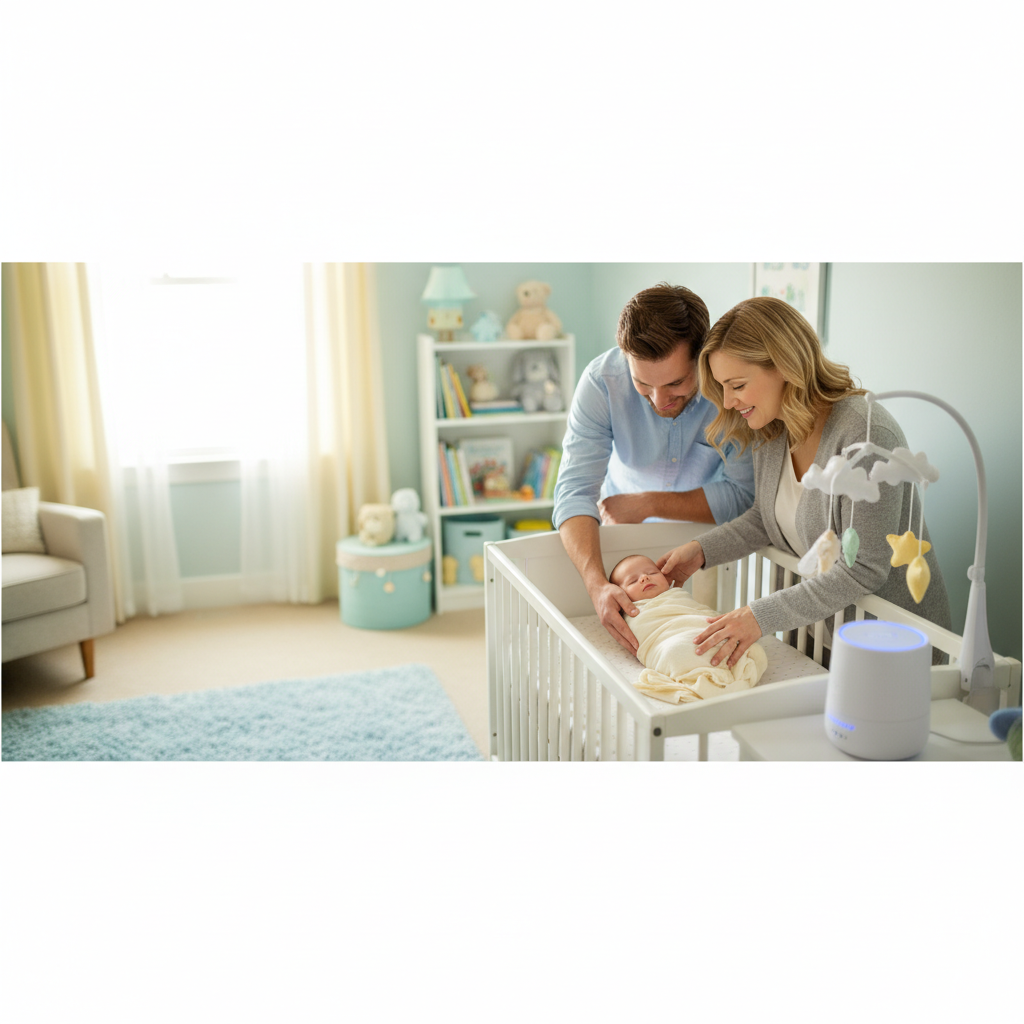
Key Takeaways
- Research shows white noise helps babies fall asleep faster — reducing sleep onset by ~5 minutes on average
- It mimics the womb environment, which is surprisingly loud at ~80dB
- Safe when used correctly: volume under 50dB, placed at least 200cm (7ft) from baby
- Effectively masks household noise that causes partial awakenings
- Not a dependency if used as part of a broader sleep routine — most families wean easily
White noise machines are one of the most popular baby sleep aids — but do they actually work, or is it just placebo for exhausted parents? Let's look at what the science says, how to use it safely, and when it might be time to stop.
What the Research Says
Multiple studies have examined white noise and infant sleep:
- Faster sleep onset: A study in Archives of Disease in Childhood found that 80% of newborns fell asleep within 5 minutes with white noise, compared to only 25% without it
- Fewer night wakings: White noise helps babies transition between sleep cycles without fully waking — the sound provides a consistent auditory cue that "it's still sleep time"
- Parent-reported improvement: Approximately 80% of parents using white noise report better sleep quality for their babies
- Reduced crying: Studies show white noise can reduce colic-related crying, likely by activating the calming reflex
The evidence is clear: white noise is not a gimmick. It's a legitimate, evidence-based sleep tool when used correctly.
Why It Works
The "4th trimester" theory explains why white noise is so effective for young babies:
- The womb is loud: Inside the uterus, babies are exposed to constant sound at approximately 80dB — louder than a vacuum cleaner. Blood flow, digestion, heartbeat, and muffled external sounds create a continuous noise environment.
- Silence is unfamiliar: A quiet nursery is actually a dramatic change from what your baby experienced for 9 months. White noise recreates that familiar soundscape.
- Calming reflex activation: Dr. Harvey Karp's research shows that white noise triggers a neurological calming reflex in newborns — it's one of the "5 S's" (swaddling, side/stomach, shushing, swinging, sucking).
- Masks disruptions: White noise creates a consistent sound floor that prevents sudden noises (doors, siblings, dogs, traffic) from causing startle reflexes and partial awakenings.
Types of Sound
Not all "white noise" is the same. Here's how different sound types compare:
| Sound Type | Character | Best For |
|---|---|---|
| White noise | Equal energy across all frequencies — "static" or "hiss" | Newborns, masking sharp sounds |
| Pink noise | More bass, less treble — "rainfall" or "waterfall" | Older babies, lighter sleepers |
| Brown noise | Deep, low rumble — "thunder" or "strong wind" | Deep sleep maintenance, very noisy environments |
| Nature sounds | Rain, ocean waves, wind through trees | Toddlers transitioning off white noise |
| Shushing | Rhythmic "shh" sound — closest to womb | Newborns (0-3 months), calming during fussiness |
For most babies under 6 months, true white noise or shushing sounds work best. As babies get older, many parents find pink noise or nature sounds are gentler while still effective.
Safety Guidelines
The AAP and pediatric sleep researchers recommend these safety practices:
- Volume under 50dB: This is the most important rule. 50dB is roughly the volume of a quiet conversation. Use a free decibel meter app at your baby's head level to check. Many machines go much louder than this — don't max them out.
- Distance of at least 200cm (7ft): Place the machine across the room, not in or on the crib. This reduces volume at the baby's ears and prevents any risk of the cord being a hazard.
- Don't run all night at full volume: Use white noise for falling asleep, then lower the volume or set a timer. Some parents keep it on low all night for masking — this is fine as long as volume stays under 50dB.
- No earbuds or headphones: Never put headphones or earbuds on a baby. The concentrated sound directly in the ear canal can cause hearing damage even at lower volumes.
- Choose continuous sounds: Avoid machines with sudden changes, music, or melodies for sleep. The sound should be constant and monotonous.
When to Use White Noise
White noise works best in these situations:
- Naps: Especially helpful for daytime sleep when household noise is unavoidable
- Bedtime: As part of the wind-down routine — turn it on when you start the bedtime routine to signal "sleep is coming"
- During sleep transitions: The 30-45 minute mark when babies cycle between light and deep sleep
- Noisy environments: Apartments, homes with older siblings, near busy roads
- Travel: Portable white noise provides consistency in unfamiliar sleep environments
Important: White noise should NOT be your baby's only sleep association. Combine it with other cues — dark room, sleep sack, consistent routine. This way, if you forget the machine or it breaks, your baby can still sleep.
When to Stop
There's no hard rule about when to stop using white noise. Many adults use it their entire lives. However, if you want to wean:
- Most families wean between 1-2 years — often when transitioning to a toddler bed or room
- Gradual volume reduction: Lower the volume slightly every 2-3 nights over 1-2 weeks until it's barely audible, then off
- No rush: If white noise is working and your child sleeps well, there's no medical reason to stop
- Consider keeping it for naps: Some families drop nighttime white noise first while keeping it for naps (when household noise is higher)
If your child is in daycare or will be sharing a room, weaning earlier may be practical — but it's a lifestyle choice, not a health requirement.
White Noise + Sleep Tracking
Here's where data gets interesting. Many parents think white noise helps — but does it actually improve YOUR baby's sleep?
With ParAI's sleep tracking, you can:
- Log sleep sessions with and without white noise
- Compare sleep duration, number of wakings, and time to fall asleep
- See AI-generated insights about what's actually working for your specific baby
- Track whether different sound types (white vs pink vs nature) produce different results
ParAI's AI analyzes your baby's sleep patterns and can tell you whether white noise is making a measurable difference — or if other factors (wake windows, room temperature, routine consistency) matter more for your child.
Try a simple experiment
Track 5 nights WITH white noise and 5 nights WITHOUT (keeping everything else the same). Log each session in ParAI and check your weekly insights. The AI will show you the actual difference in sleep duration and night wakings — no guessing needed.
FAQ
Can white noise damage my baby's hearing?
Not if used correctly. The risk comes from excessive volume (above 50dB) at close range for extended periods. A 2014 study found that some machines can exceed safe levels when placed in the crib at maximum volume — which is why distance and volume limits matter. At 200cm away and under 50dB, there is no evidence of hearing risk.
Will my baby become dependent on white noise?
White noise is a sleep association, like a dark room or sleep sack. Most babies wean off it easily with gradual volume reduction. It's far less problematic than associations that require parental intervention (rocking, feeding to sleep). If your baby can fall asleep with white noise independently, that's a healthy sleep skill.
Which is better — an app or a dedicated machine?
Dedicated machines are generally better because: they don't have notification sounds, they produce more consistent audio quality, they don't drain your phone battery, and they don't expose your baby to screen light. However, a phone with Do Not Disturb mode works fine for travel. Avoid machines with lights, projectors, or music options — simple is better.
Does white noise work for toddlers too?
Yes. Many toddlers and preschoolers benefit from white noise, especially during the nap-to-no-nap transition or in noisy households. Older children often prefer pink noise or nature sounds over harsh white noise. There's no age limit — plenty of adults use it too.
Related reading: Safe Sleep & SIDS Prevention · Baby Fights Sleep · Newborn Sleep Schedule · Baby Wake Windows Guide · How SmartSpot Works
Struggling with Sleep? Try ParAI's AI Sleep Coach
ParAI's AI Sleep Coach creates a personalized sleep plan based on your baby's age, temperament, and patterns. Daily check-ins, progress tracking, and evidence-based guidance.