Key Takeaways
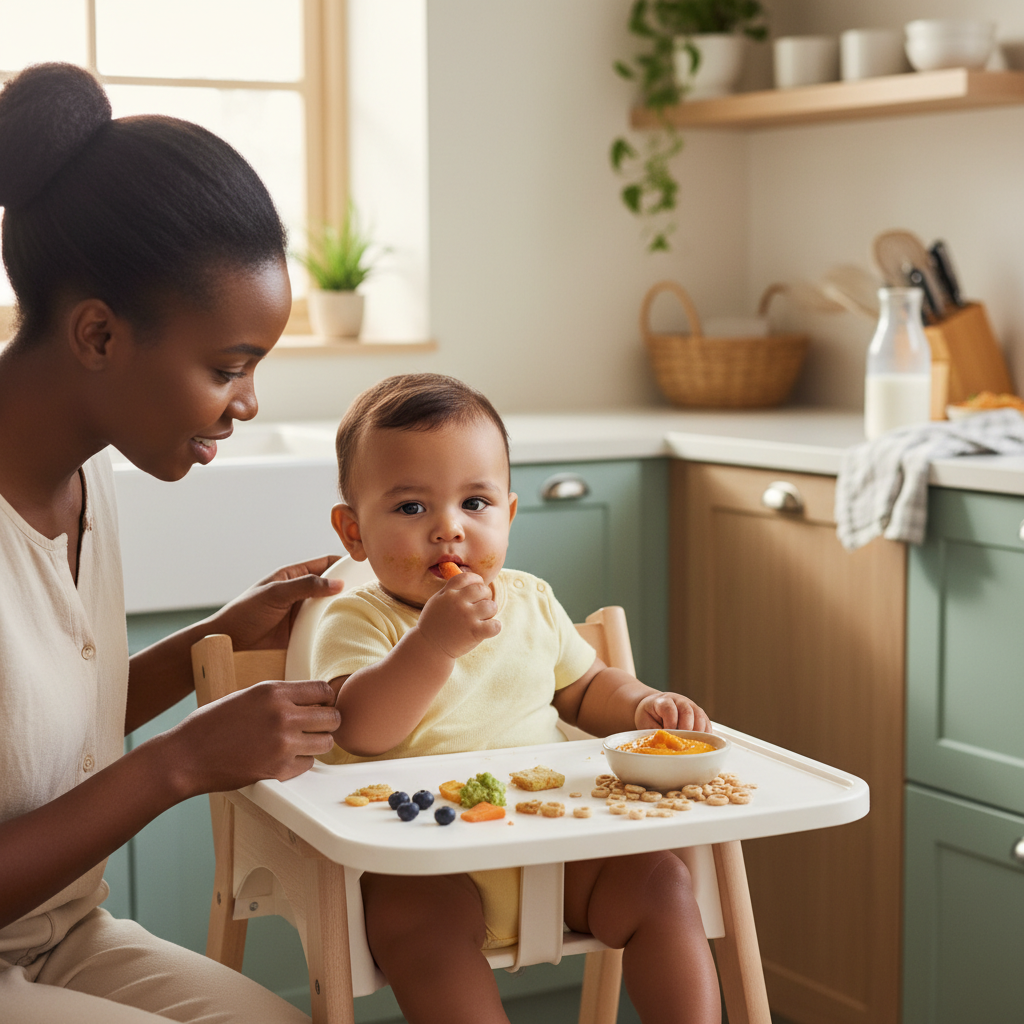
- Baby-led weaning lets babies self-feed soft finger foods from around 6 months
- Wait for readiness signs: sitting unassisted, lost tongue-thrust reflex, developing pincer grasp
- Cut food into finger-length strips for 6–8 months, smaller pieces once pincer grasp develops
- Gagging is normal and protective — choking is silent with face color change
- A combined BLW + puree approach works perfectly well
What Is Baby-Led Weaning?
Baby-led weaning (BLW) is an approach to introducing solid foods where the baby feeds themselves from the very start — no spoon-feeding, no purees. Instead of being fed by a parent, the baby picks up soft, appropriately-sized finger foods and brings them to their own mouth.
The concept was popularized by Gill Rapley and is based on the idea that babies around 6 months old are developmentally capable of self-feeding. BLW encourages babies to explore textures, tastes, and shapes at their own pace, which may support the development of healthy eating habits and fine motor skills.
See also: Introducing Solid Foods: When to Start, What to Feed, and How and Foods to Avoid During Pregnancy: The Complete Safety Guide.
With BLW, babies join family mealtimes from the start. They eat the same foods as the rest of the family (with appropriate modifications for safety), which simplifies meal prep and encourages social eating.
BLW doesn't mean no help
You still prepare and offer the food, sit with your baby, and supervise every bite. BLW simply means the baby controls what goes into their mouth and how fast they eat.
Signs of Readiness
Before starting BLW, your baby should show ALL of these developmental signs (typically around 6 months):
- Sits upright unassisted — can maintain a stable sitting position without slumping, which is essential for safe swallowing
- Lost the tongue-thrust reflex — no longer automatically pushes food out of the mouth with the tongue
- Developing pincer grasp — beginning to pick up objects between thumb and forefinger (full pincer grasp comes later around 8–9 months)
- Shows interest in food — reaches for food, watches you eat intently, opens mouth when food is offered
- Good hand-to-mouth coordination — can bring objects to their mouth accurately
Don't start too early
Starting before 6 months or before readiness signs appear increases the risk of choking. Being a certain weight, waking at night, or watching you eat alone are NOT reliable readiness indicators.
Best First Foods
The best BLW starter foods are soft enough to squish between your fingers, easy to grip, and nutritious. Here are excellent first options:
- Avocado strips — rich in healthy fats, soft texture, easy to hold (roll in hemp seeds if too slippery)
- Ripe banana — leave half the peel on for grip, or cut into spears
- Steamed broccoli florets — the "tree" shape makes a natural handle
- Sweet potato wedges — steam or roast until very soft
- Soft meat strips — slow-cooked chicken thigh or ground beef formed into strips (excellent iron source)
- Steamed carrot sticks — cook until easily squished, never serve raw
- Toast strips — lightly toasted bread cut into fingers, can top with nut butter
- Egg strips — well-cooked omelet cut into strips
How to Serve Food Safely
How you cut and prepare food is just as important as what you offer. The shape and size should match your baby's developmental stage:
| Age | Shape | Size | Why |
|---|---|---|---|
| 6–8 months | Finger-length strips or sticks | About the length of your finger, thick enough to grip | Baby uses a palmar (whole-hand) grasp and eats what sticks out of their fist |
| 9–12 months | Smaller pieces, diced | Pea-sized to chickpea-sized | Pincer grasp develops — baby can pick up small pieces |
The squish test
Press the food between your thumb and forefinger. If it squishes easily, it's soft enough for your baby. If it doesn't, cook it longer or choose something softer.
Additional safety rules:
- Always supervise — never leave baby alone with food
- Baby should be seated upright in a highchair, not reclined
- Remove seeds, pits, and tough skins
- Avoid round, hard foods (whole grapes, cherry tomatoes — cut lengthwise)
- Never offer food in a moving car or stroller
BLW vs Purees: Can You Do Both?
Absolutely. A combined approach — sometimes called "baby-led introduction to solids" (BLIS) — is perfectly valid and increasingly popular. You might offer purees on a preloaded spoon (baby brings it to their own mouth) alongside finger foods.
Benefits of combining:
- Easier to ensure iron-rich foods are consumed (iron-fortified cereal as puree)
- Less pressure on parents who worry about intake
- Baby still develops self-feeding skills with finger foods
- Works well for daycare settings where staff may be less comfortable with BLW
There's no evidence that a strict BLW-only approach is superior to a combined one. Do what works for your family.
Choking vs Gagging
Understanding the difference between gagging and choking is the most important safety knowledge for BLW parents:
| Sign | Gagging (Normal) | Choking (Emergency) |
|---|---|---|
| Sound | Loud coughing, retching, sputtering | Silent or very quiet — no air moving |
| Face color | May turn red briefly | Turns blue or pale |
| Eyes | May water, baby looks surprised | Wide, panicked look |
| Action needed | Stay calm, let baby work it out | Infant CPR — back blows and chest thrusts |
| Purpose | Protective reflex that pushes food forward | Airway is blocked |
Take an infant CPR class
Before starting BLW, both parents and caregivers should complete an infant CPR course. Knowing what to do in a choking emergency gives you confidence and keeps baby safe.
Gagging is very common in the first weeks of BLW and decreases as baby learns to manage food in their mouth. The gag reflex in young babies is triggered further forward on the tongue than in adults, which means it activates before food reaches the airway — it's a safety mechanism.
Sample BLW Schedule by Age
Remember: before 12 months, breast milk or formula is still the primary source of nutrition. Food is for exploration, practice, and gradually increasing intake.
| Age | Meals | What to Offer | Milk Feeds |
|---|---|---|---|
| 6 months | 1 per day | 2–3 soft finger foods to explore, no pressure to eat | On demand (5–6) |
| 7–8 months | 2 per day | Increasing variety, introduce allergens, offer water in open cup | 4–5 |
| 9–10 months | 3 per day | Family meals modified for safety, self-feeding with preloaded spoon | 3–4 |
| 11–12 months | 3 meals + 1–2 snacks | Most family foods, smaller pieces, more independence | 2–3 |
Timing tip
Offer solids about an hour after a milk feed so baby isn't too hungry (frustrated) or too full (disinterested). Mid-morning is often the best time to start.
Track Feedings in Seconds with Natural Language
Just type "150ml bottle at 3pm" and ParAI logs it instantly. No forms, no tapping through menus. Plus AI insights on feeding patterns and schedules.