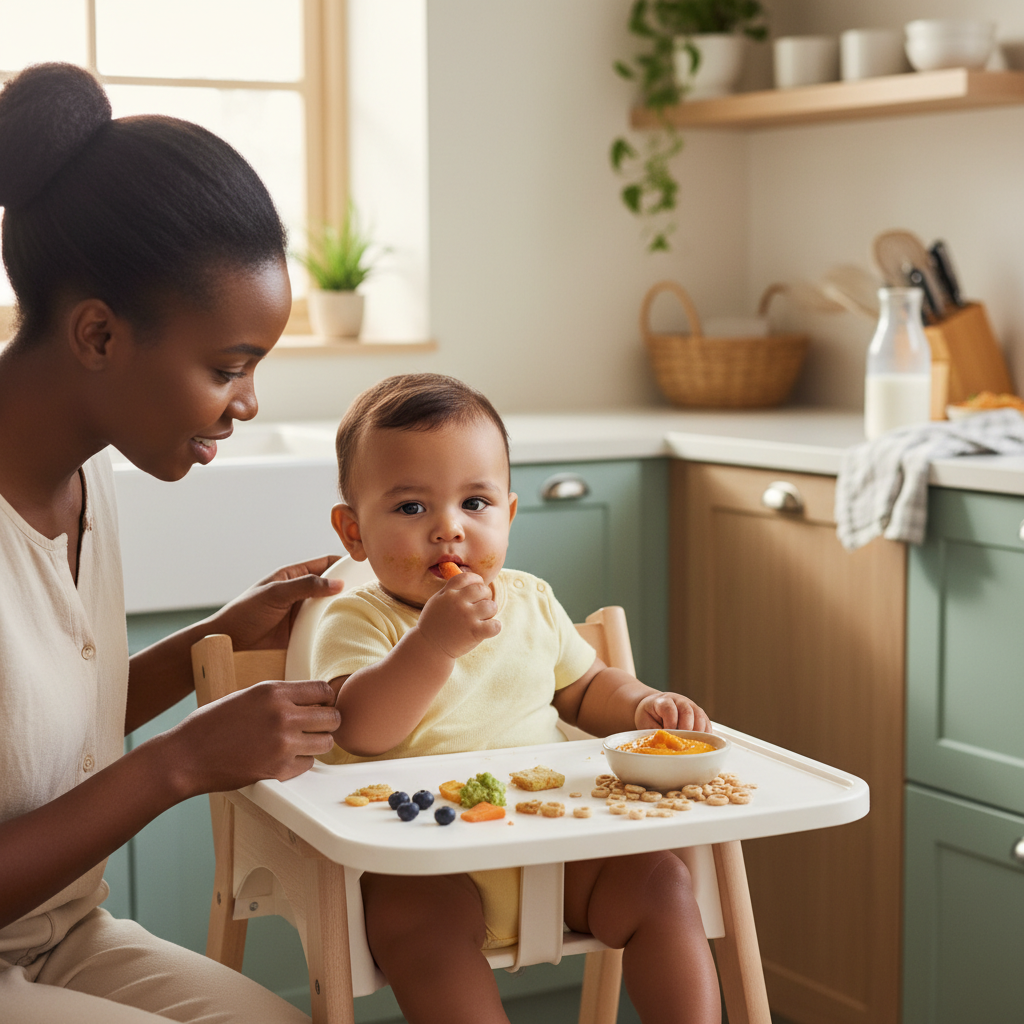
Key Takeaways
- 9-month-olds need 20–28 oz (600–840ml) of breast milk or formula per day (3–4 feeds)
- Solids expand to 3 meals per day plus 1–2 snacks
- Texture advances: soft finger foods, mashed, and small pieces — moving beyond purees
- Pincer grasp is developing — encourage self-feeding with appropriate foods
- Night feeds should be minimal (0–1) by this age
At 9 months, your baby is becoming a confident eater. Milk is still important, but solids now play a bigger nutritional role. Here's exactly how much your 9-month-old needs and what to serve.
Breast Milk & Formula at 9 Months
| Feeding Type | Per Feeding | Feedings/Day | Total/Day |
|---|---|---|---|
| Breastfed | Varies (nurse fully) | 3–4 sessions | 20–28 oz (600–840ml) |
| Formula-fed | 6–8 oz (180–240ml) | 3–4 bottles | 20–28 oz (600–840ml) |
| Solids | 2–4 tablespoons | 3 meals + 1–2 snacks | Growing role |
Milk is decreasing — that's normal
As solids increase, milk naturally decreases from the 24–32 oz (720–960ml) at 6 months to 20–28 oz (600–840ml) now. If your baby is eating well at meals, 3–4 milk feeds per day is plenty.
See also: How Much Should a 6 Month Old Eat? for comparison.
Solids: 3 Meals + Snacks
By 9 months, your baby should be eating 3 structured meals per day with 1–2 small snacks. Offer variety across food groups:
- Protein — soft shredded meats, beans, scrambled eggs, cheese cubes
- Grains — toast strips, small pasta, rice, oatmeal
- Fruits — ripe banana pieces, soft berries, diced peach, avocado
- Vegetables — soft cooked broccoli, sweet potato cubes, steamed carrots
- Dairy — plain yogurt, cottage cheese, shredded cheese
Portions are roughly 2–4 tablespoons of each food group per meal, but let your baby's appetite guide you.
Learn more: Introducing Solid Foods: A Complete Guide.
Best Finger Foods for 9 Month Olds
At 9 months, most babies are ready to move beyond purees. Offer soft foods they can pick up and self-feed:
- Soft fruits — ripe banana, avocado slices, steamed apple, diced mango
- Cooked veggies — sweet potato cubes, steamed broccoli florets, soft peas
- Proteins — shredded chicken, flaked fish, small bean pieces, egg strips
- Grains — toast fingers, soft pasta spirals, puffed rice cereal, pancake strips
- Dairy — cheese cubes, thick yogurt on a preloaded spoon
The squish test
If you can squish the food between your thumb and finger, it's soft enough for your 9-month-old. Anything that doesn't pass this test is a choking risk.
See also: Baby-Led Weaning Guide and Choking Hazards & Baby First Aid.
Self-Feeding & the Pincer Grasp
Around 9 months, babies develop the pincer grasp — picking up small items between thumb and forefinger. This is a game-changer for self-feeding:
- Offer small, soft pieces they can practice picking up (peas, blueberry halves, small pasta)
- Let them hold a preloaded spoon while you feed with another
- Expect mess — it's part of learning. Use a large bib and a mat under the high chair
- Offer water in an open cup or straw cup (60–120ml with meals)
Self-feeding builds fine motor skills, hand-eye coordination, and independence. Resist the urge to take over — even if it's slow and messy.
Sample Daily Feeding Schedule
| Time | Feeding | Amount |
|---|---|---|
| 6:30 AM | Breast milk / Formula | 6–8 oz (180–240ml) |
| 8:00 AM | Breakfast (solids) | 2–4 tbsp each: grain + fruit |
| 10:00 AM | Snack | Finger food + 60ml water |
| 11:30 AM | Breast milk / Formula | 6–8 oz (180–240ml) |
| 12:30 PM | Lunch (solids) | 2–4 tbsp each: protein + veggie + grain |
| 3:00 PM | Breast milk / Formula | 6–8 oz (180–240ml) |
| 5:30 PM | Dinner (solids) | 2–4 tbsp each: protein + veggie + fruit |
| 7:00 PM | Breast milk / Formula | 6–8 oz (180–240ml) |
Milk feeds happen around solids now, not before. Some babies prefer milk first thing in the morning and at bedtime, with solids as the main event during the day.
Night Feeds at 9 Months
By 9 months, most babies can sleep through the night without feeding. Night feeds should be 0–1 at most.
- If your baby is eating 3 solid meals plus adequate milk during the day, night feeds are no longer nutritionally necessary
- Persistent night waking is usually habit, not hunger — consider gentle sleep training
- If still offering one feed, keep it brief and boring to discourage waking for it
Common Feeding Issues
- Food throwing — Normal exploration. Offer small amounts at a time and calmly say "food stays on the tray." Don't react dramatically.
- Gagging vs choking — Gagging (loud, coughing, face red) is a safety reflex and normal with new textures. Choking (silent, face turning blue) requires intervention. Learn infant CPR.
- Refusing purees, wanting texture — Many 9-month-olds reject smooth purees. This is a sign they're ready for more texture — follow their lead and offer soft finger foods.
- Eating less some days — Appetite varies with teething, illness, and growth spurts. Trust your baby's hunger cues.
FAQ
How many times a day should a 9-month-old eat?
3 solid meals + 1–2 snacks + 3–4 milk feeds (breast or formula). That's roughly 7–9 feeding occasions per day.
Can I give my 9-month-old cow's milk?
No. Cow's milk as a main drink should wait until 12 months. Small amounts in cooking or mixed into foods is fine.
How much water should a 9-month-old drink?
2–4 oz (60–120ml) of water with meals, offered in an open cup or straw cup. Water is for practice — milk still provides hydration.
My 9-month-old only wants to self-feed. Is that okay?
Yes! If they're eating enough variety and gaining weight well, self-feeding is excellent for development. Offer preloaded spoons for foods like yogurt.
Should I still offer purees at 9 months?
Only if your baby enjoys them. Most 9-month-olds prefer texture. You can offer thick, lumpy mashes as a middle ground between purees and finger foods.
Track Feedings in Seconds with Natural Language
Just type "150ml bottle at 3pm" and ParAI logs it instantly. No forms, no tapping through menus. Plus AI insights on feeding patterns and schedules.